
- Introduction: UX Design Isn't A One-time Effort
- Section 01: Making The Business Case For UX/UI
- Section 02: How To Build A Successful UX Strategy
- Section 03: How to Overhaul Your UX/UI Without Alienating Users
- Section 04: Key UX Metrics
- Section 05: Measuring the User Experience ROI
- Section 06: How to Choose a UX Partner
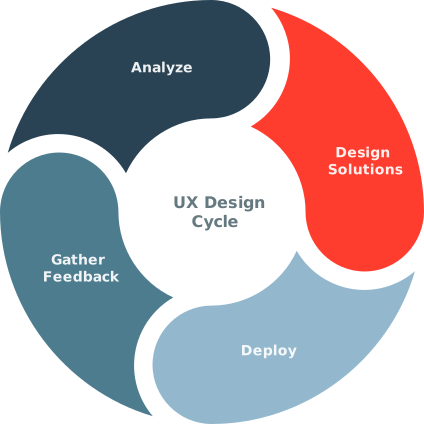
UX Design Isn't A One-time Effort
Like any important business tool, your web-based applications and interfaces must be easy to use, intuitive and keep up with changing technologies, behaviours and expectations. Products evolve, and without an iterative approach to UX design, your applications risk looking and feeling antiquated.
Good UX adds value to any software dev project by delivering clear, tangible benefits. For customer-facing applications, a better experience can increase customer satisfaction, retention and market share. For internal enterprise applications, a better UX/UI will boost employee engagement as well as productivity. In all cases, improving the usability of a product cuts development and support costs.
This guide outlines how software leads and teams can position their development projects as a profit centre, plot out a strategic road map for redesign and then show clear ROI.
Build the Business Case
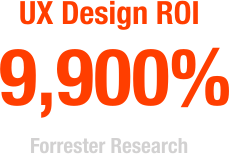
Sometimes investing in UX can seem like a “nice to have” rather than a “must have.” However, investing in UX has a direct financial impact on your software development project. It can help reduce calls to support centres and improve employee productivity. As research by Forrester shows, on average, every dollar invested in UX brings 100 dollars in return. That's an ROI of a whopping 9,900 percent. In Section 1, we outline just how to build the business case for UX investment.
Read more about how to build the business case for UX in your organizationHow to Build a Successful UX/UI Redesign Strategy

When UX design teams are involved early in a project, it helps to improve decision making and better prioritize development tasks. A successful UX/UI strategy will go a long way in reducing dev costs. By implementing a defined UX strategy with a clear road map, you can drastically reduce the potential for tedious and unnecessary development rework. Explore Section 2 to see the five foundational factors for a successful redesign strategy.
Read more about how to create a UX/UI redesign strategyHow to Overhaul Your UX/UI without Alienating Users

Adding or removing features and changing the functionality of your application is a delicate situation. You need to help users smoothly transition from the older version of your app to the new one, seamless and efficiently. With a strategy in hand, how do you go about an iteration on your enterprise application without alienating your users? Find out in Section 3.
Read more about how to overhaul your UX/UIKey UX Metrics

When measured correctly, revenue and cost reductions from UX projects can be directly correlated with your investment. This is why it is increasingly important to have metrics in place in relation to your software development projects. These metrics will place a critical role in being able to show UX as a profit-centre. Section 4 covers key metrics that you may want to benchmark and track.
Read more about UX merticsMeasuring the User Experience ROI

Now that the project is done and dusted, what dividends are better user experiences paying? We share various calculations you can use to show that the money that went into UX design and the software development has delivered a strong return on investment. Check out Section 5 to get the tools to measure your project.
Read more about measuring UX ROIHow to Choose a UX Partner

With so many UX companies out there, how can you find a partner that will quickly and efficiently integrate into your software team? In this wrap-up, we outline a few key criteria your UX/UI partner should have. See what to look for in Section 6.
Read more about how to choose a UX partner