Is UX Design Still Worth Learning in 2026? An Honest Guide From People Who Hire Designers
If you're thinking about studying UX design in 2026, the question on your mind probably isn't "which school is best." It's "should I even do this?"
Fair question. The junior market is hard right now. AI tools produce working prototypes from a text prompt. Several of the bootcamps every career-change article recommended two years ago no longer exist. And yet studios like ours still hire designers, clients still can't ship usable enterprise software without them, and the skills that make someone valuable have never been easier to name.
So: first the market reality, then the paths — degrees, certificates, bootcamps, and the new AI skill layer — with current prices where schools publish them. We design enterprise software for a living and we've sat on the hiring side of this market for over 20 years, so we'll also tell you what we look for when a portfolio lands in our inbox.
What you're walking into
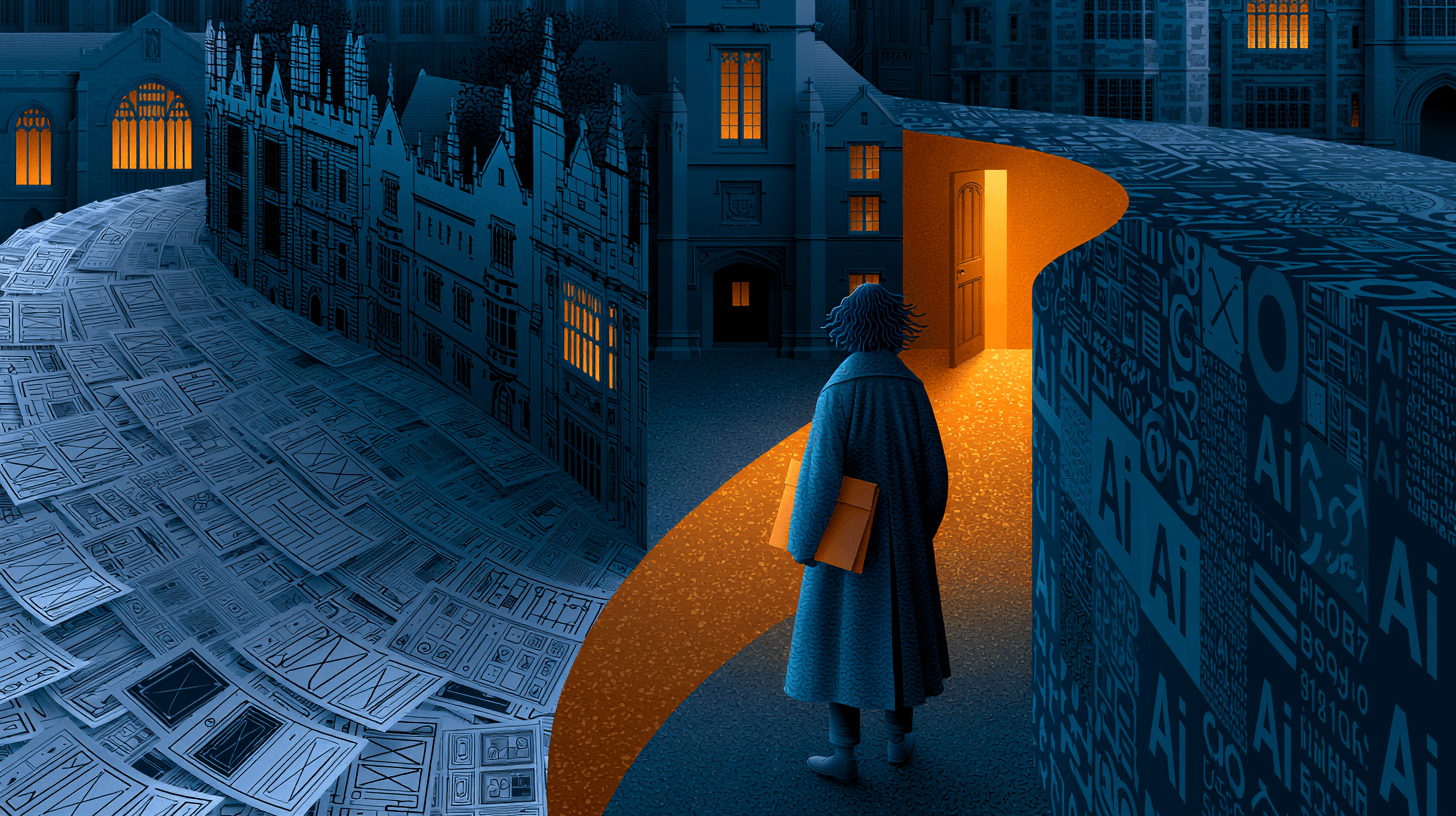
Three things define this market, and it's worth being specific about each.
The junior market tightened while the senior market recovered. Nielsen Norman Group's State of UX 2026 describes a field that stabilized after the 2023–24 downturn, but unevenly: teams are holding steady and senior roles are being filled, while entry-level openings remain scarce and highly competitive — industry hiring coverage this spring described junior postings drawing hundreds of applicants each.
Here in Canada, the picture is blunter. The Government of Canada's Job Bank rates user experience designers as facing a "strong risk of labour surplus" through 2033, with three-year prospects rated "very limited" in Ontario and Quebec. That's the official federal outlook, and no school brochure will quote it to you.
This is not the same as "the field is dying." The U.S. Bureau of Labor Statistics still projects about 7% growth for digital designers through 2034 — faster than average, just nothing like the 20%-plus gold-rush numbers of 2020–2022. Pay has held up too: Robert Half's 2026 Canadian guide puts a mid-level UX designer at about $98,000 CAD, with directors above $117,000. The work exists. What disappeared is the guarantee that a 12-week course leads to it.
AI took over the first draft. The Spring 2026 UX Tools State of Prototyping survey (1,478 working designers) found that 43.8% now spend at least half their build time working with AI-generated code, and five of the ten tools designers use weekly are AI tools — Claude, ChatGPT, Figma Make, and their relatives.
On the hiring side, NACE's Spring 2026 employer survey found that over a third of entry-level positions now require AI skills — nearly triple the figure from fall 2025. Notably, only 11% of those employers talked about AI as a way to replace roles. They want people who can use it.
The bootcamp era ended, quietly. CareerFoundry — a fixture of every "how to switch careers into UX" article for a decade — filed for insolvency in late 2025 and ceased operations in early 2026. InVision — once a $2-billion design company whose free courses taught thousands of beginners — shut down entirely. Springboard still operates but dropped its money-back job guarantee for the UX track. The job-guarantee business model assumed a market where every graduate got hired within six months. That market is gone, and the schools built on it went with it.
So is it worth it?
It depends on which version of the plan you're holding.
If the plan is "take a short course, build three portfolio projects from the course templates, apply to a hundred junior openings" — no. That pipeline is jammed with thousands of people holding identical portfolios, and the tasks a junior was traditionally hired to do (wireframes, UI variations, style tweaks) are exactly the tasks AI tools now do in minutes.
If the plan is to become someone who understands users, evidence, and product decisions — and who uses AI tools fluently along the way — the honest answer is yes, with patience. Every serious survey says the same thing about where the value moved. NN/g's researchers, after testing eight AI prototyping tools against real design tasks, concluded that the tools "lack the sophistication to weigh design tradeoffs" and that the real work remains "in the judgment, empathy, and intent that only human designers can provide."
Our experience matches. AI gets our teams to a testable screen dramatically faster. It has yet to tell us why a dispatcher misreads an alert at 3 a.m., or which of a client's fourteen stakeholders is describing the actual workflow.
One more shift worth naming: the roles growing fastest are researchers, accessibility specialists, and designers who work well inside complex domains — healthcare, finance, industrial software. Generic "app designer" is the crowded lane. Specialists are not.
The new skill on the syllabus: vibe design
You'll see the terms "vibe coding" and "vibe design" everywhere this year. Strip the hype and they describe something real: instead of drawing static mockups, a designer prompts an AI tool — Figma Make, v0, Lovable, Bolt, Cursor, Claude — and gets a working, clickable prototype, then shapes it through conversation and direct edits. The prototype, not the mockup, becomes the deliverable.
Two things every learner should know before rearranging their study plan around this.
First, it's already table stakes, not a differentiator. When half the profession uses these tools weekly, "I can prompt Lovable" is the 2026 equivalent of "I know Figma." Learn the tools — most have free tiers, and an afternoon with Figma Make or v0 teaches you more than any article — but don't expect the tools alone to make you employable.
Second, know where they fail, because that's where the jobs are. Across NN/g's testing and practitioner write-ups, the same failure modes repeat: generic visual style, broken accessibility, hand-waved edge cases, and prototypes that ignore the existing design system. In enterprise work — our world — those aren't cosmetic problems; they're the difference between software a hospital can deploy and software it can't. The designer who can take an AI-generated prototype and make it accessible, consistent, and correct for real data is more valuable now than before these tools existed.
There is no university degree in vibe design, and we'd be skeptical of anyone selling one. It's a skill you pick up in the tools, ideally on top of real design fundamentals. If you want structure, Designlab now offers AI-focused product design courses and General Assembly lists a UX Design for AI Experiences course (US$2,950; check current session dates) — but treat these as a layer, not a foundation.
The paths in 2026, honestly compared
University programs: for depth and the long game
A degree still makes sense in two cases: you're starting your career and want the co-op pipeline, or you're aiming at research-heavy or specialized roles where credentials and depth matter.
In Canada, the strongest options we'd point to:
Wilfrid Laurier University — BDes in User Experience Design (Brantford). Still the country's most direct undergraduate route into UX, four years, with an optional paid co-op — and in this market, the co-op is the point. Laurier also offers a newer UX Design MSc if you're past the undergraduate stage. Tuition varies by load; use Laurier's cost calculator.
University of Toronto — Master of Information, UXD concentration. Two years, with coursework, thesis, and co-op pathways. The research training here maps directly onto the roles that are actually growing. Current fees are on U of T's student accounts site.
University of Waterloo — Master of Digital Experience Innovation. Delivered fully online, eight months full-time or twenty part-time — one of the few Canadian graduate credentials you can earn without quitting your job.
Humber Polytechnic — UX Design graduate certificate (Toronto; formerly Humber College). Three semesters, mostly in-person. The last published fees were about $6,971 CAD domestic — still the best tuition-to-credential ratio in the province for someone who already holds a degree.
OCAD University — UX Design micro-credential (Toronto). Two continuing-education courses, stackable toward a certificate, for testing the water without committing a year.
In the U.S., Parsons' one-year MPS in Communication Design (digital product concentration) is still accepting students and pairs design thinking with front-end code.
Certificates and subscriptions: the affordable middle
Google UX Design Certificate (Coursera). Around six months at ten hours a week, US$49/month — most people finish under US$300. Over 1.5 million people have enrolled, which is both its strength and its problem: it's a solid, structured introduction, and it will not make your portfolio stand out on its own. Take it for the foundation, then build projects it doesn't assign.
Nielsen Norman Group UX Certification. The heavyweight professional credential — live courses taught by working researchers, roughly US$6,400 for the base certification. Overkill for a beginner; widely respected for practitioners formalizing their expertise, and often employer-funded.
Interaction Design Foundation. US$15–22/month for unlimited access to forty-plus courses. The best per-dollar theory library in the field. Theory is exactly what AI tools don't teach you, so this pairs well with hands-on tool time.
Bootcamps: read the fine print that's left
The surviving bootcamps are the ones that competed on teaching rather than guarantees. Designlab's UX Academy (from about US$7,999, 21–36 weeks, mentor-led) has the strongest mentorship model still standing and has folded AI workflows into the curriculum. Springboard's UI/UX track (US$7,190 upfront, nine months) continues, minus the job guarantee. General Assembly still runs its UX bootcamp but no longer publishes tuition — ask directly, and ask hard questions about placement rates from 2025, not 2021.
Before paying any bootcamp five figures in 2026, ask three questions: What happened to your job-placement numbers in the last two years? How much of the curriculum covers AI-assisted workflows? Can I speak to a graduate who got hired in the past twelve months? A school that hesitates on any of these is telling you something.
Free and self-directed: better than it's ever been
Figma Learn now offers structured official courses that didn't exist in 2020. The free tiers of Figma Make, v0, Lovable, and Claude are a real design education in themselves if you use them deliberately — pick a workflow you know, build it, then fix everything the AI got wrong. Documenting that process is a better portfolio piece than another recipe app.
Where to start
If you're not sure yet, don't spend real money to find out. Figma Learn and the free tiers of the AI tools cost nothing; the Google certificate adds structure for under US$300 total. Already hold a degree and switching careers in Ontario? Humber's certificate is the strongest price-to-credential option. Aiming at research roles or complex enterprise work? That's where a U of T or Laurier education repays its cost. Working full-time? Waterloo's online MDEI is built for exactly that. Bootcamps sit in the middle: worth it only if the mentorship model fits how you learn, and only after asking the three questions above.
What we actually look for in 2026
We're an enterprise UX studio. Our projects are dispatch consoles, lab instruments, plan-review systems — software where a design mistake costs money or safety, not just engagement. When we review candidates, here's what separates the shortlist from the pile:
Evidence of thinking, not deliverables. Anyone can show polished screens now; AI made sure of that. We look for the reasoning — what you learned from users, what you tried that failed, why the final version is shaped the way it is.
Comfort with constraints. Compliance rules, legacy systems, eight-year-old browsers on factory floors, users who've run the same green-screen terminal for two decades. Candidates who treat constraints as the interesting part of the problem do well here. Candidates who need a blank canvas don't.
AI fluency with skepticism. We expect you to use these tools — we do. We also expect you to catch what they get wrong, because in our work, an AI-hallucinated interaction pattern in a dispatch console isn't a style issue.
Research skills. The single most durable capability in the field. Tools generate screens; nothing generates the truth about your users.
None of that requires a specific school. All of it takes deliberate practice, real projects, and more patience than anyone needed in 2020. The field didn't die. It grew up.
Frequently asked questions
Is UX design still a good career in 2026?
For specialists, yes. Senior roles, research roles, and domain-specific design (healthcare, finance, industrial, enterprise SaaS) are recovering and pay well — around $98,000 CAD mid-level in Canada per Robert Half. The generic junior path is the hard road: Canada's Job Bank projects a labour surplus for UX designers through 2033, so differentiation matters more than credentials.
Do I need a degree to become a UX designer?
No, and most working designers don't have a UX-specific one. A degree buys you depth, co-op placements, and research training. What every path requires is a portfolio showing real reasoning about real problems — something no credential substitutes for.
Will AI replace UX designers?
It has already replaced some of the production work — first-draft screens, wireframes, UI variations. Employer surveys show companies hiring for AI skills rather than replacing roles with AI (only 11% of employers in NACE's 2026 survey framed AI as replacement). The judgment work — research, tradeoffs, accessibility, edge cases — is where the tools consistently fail and where hiring holds.
What's the cheapest legitimate way to start in 2026?
Free: Figma Learn plus the free tiers of AI prototyping tools. Under $500: the Google UX Certificate (~US$300 total) plus an Interaction Design Foundation membership. Spend money on a degree or bootcamp only after you've confirmed you like the work.
What is vibe design?
Using AI tools (Figma Make, v0, Lovable, Claude and similar) to generate working prototypes from prompts instead of drawing static mockups, then refining through iteration. As of 2026 roughly 44% of designers spend half their build time this way. It's a workflow skill worth learning — and not a substitute for design fundamentals.
ROSSUL has designed UX for enterprise software — SaaS platforms, embedded instruments, mission-critical internal tools — for more than 20 years. If you're building something complex, see our case studies or talk to us.